Global Pharma supplies medical supplies to hospitals, laboratories, nursing home, clinic, home care service, medical professionals, retailer & pharmacies, government agencies, medical institution and private sector businesses.
A high elastic bandage is a flexible stretch bandage designed to wrap around a body part and provide adjustable support and compression.
Elastic bandages are commonly used around joints and soft tissues such as the ankle, knee, wrist, hand, or shoulder. Their stretch allows the bandage to conform to different body contours while providing a secure supportive wrap.
In minor soft-tissue injuries, elastic wrapping may be used as part of an overall care plan to provide support and help manage swelling. The amount of compression depends on how the bandage is applied, so it should feel firm and supportive without becoming excessively tight.
A high elastic bandage does not replace appropriate medical assessment, immobilization, or other treatment when an injury is severe. The type of injury, body area, required support, circulation, and appropriate bandage width should all be considered before use.
What Are the Benefits of an Elastic Bandage?
An elastic bandage can provide external support around an injured or vulnerable body area while still allowing the level of tension to be adjusted during application.
Helps Manage Swelling
Compression wrapping may be used as part of the management of certain minor soft-tissue injuries to help control swelling, particularly when combined with rest, appropriate cold therapy, and elevation.
Conforms to Body Contours
Stretchable fabric can adapt to areas such as the ankle, knee, wrist, hand, or shoulder, allowing the bandage to follow the shape of the body more closely than a rigid dressing.
Reusable Support for Different Areas
Depending on the product instructions and clinical need, elastic bandages can provide flexible support across different body areas using an appropriate width and wrapping technique.
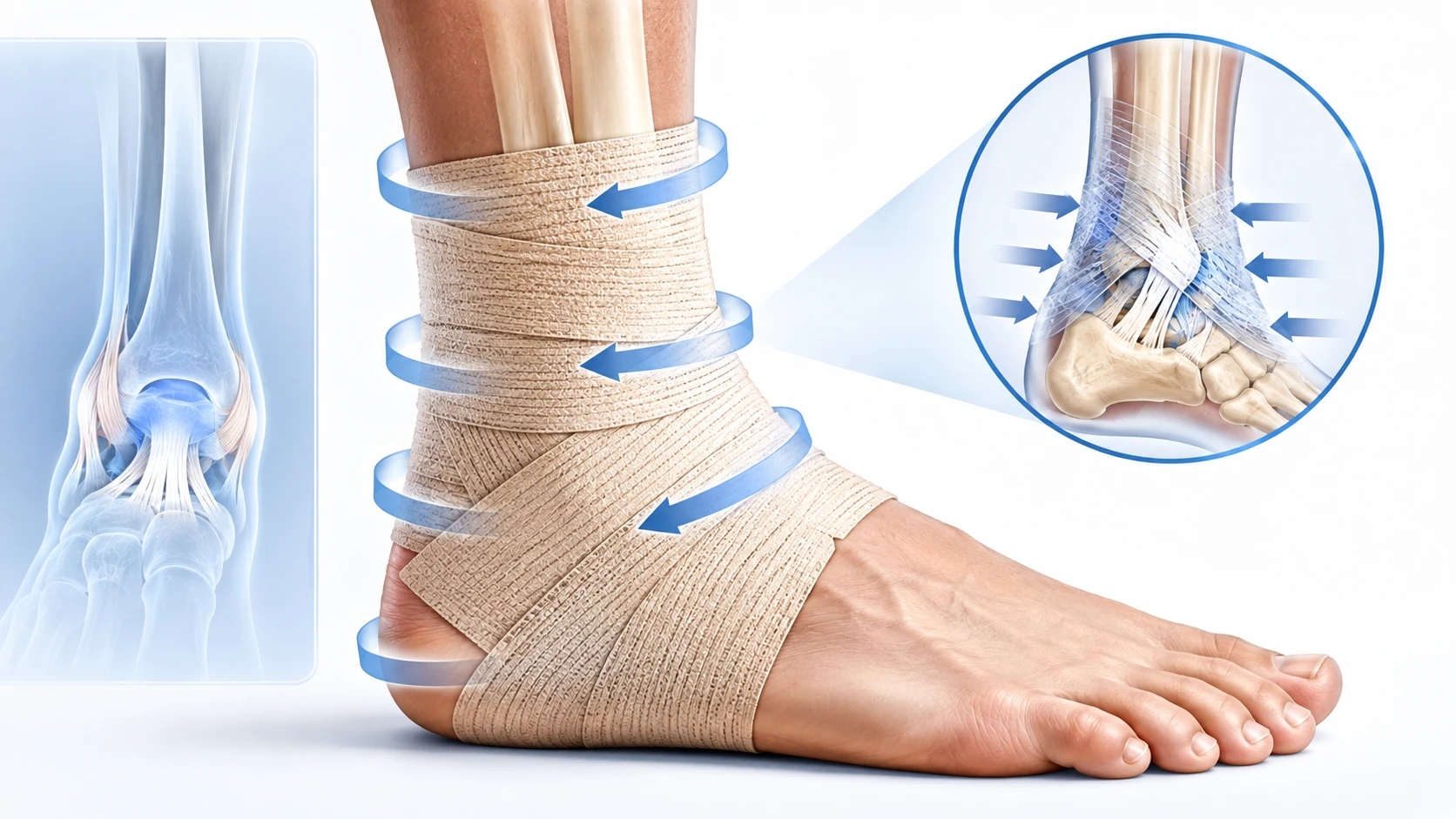
Ankle and Foot Support
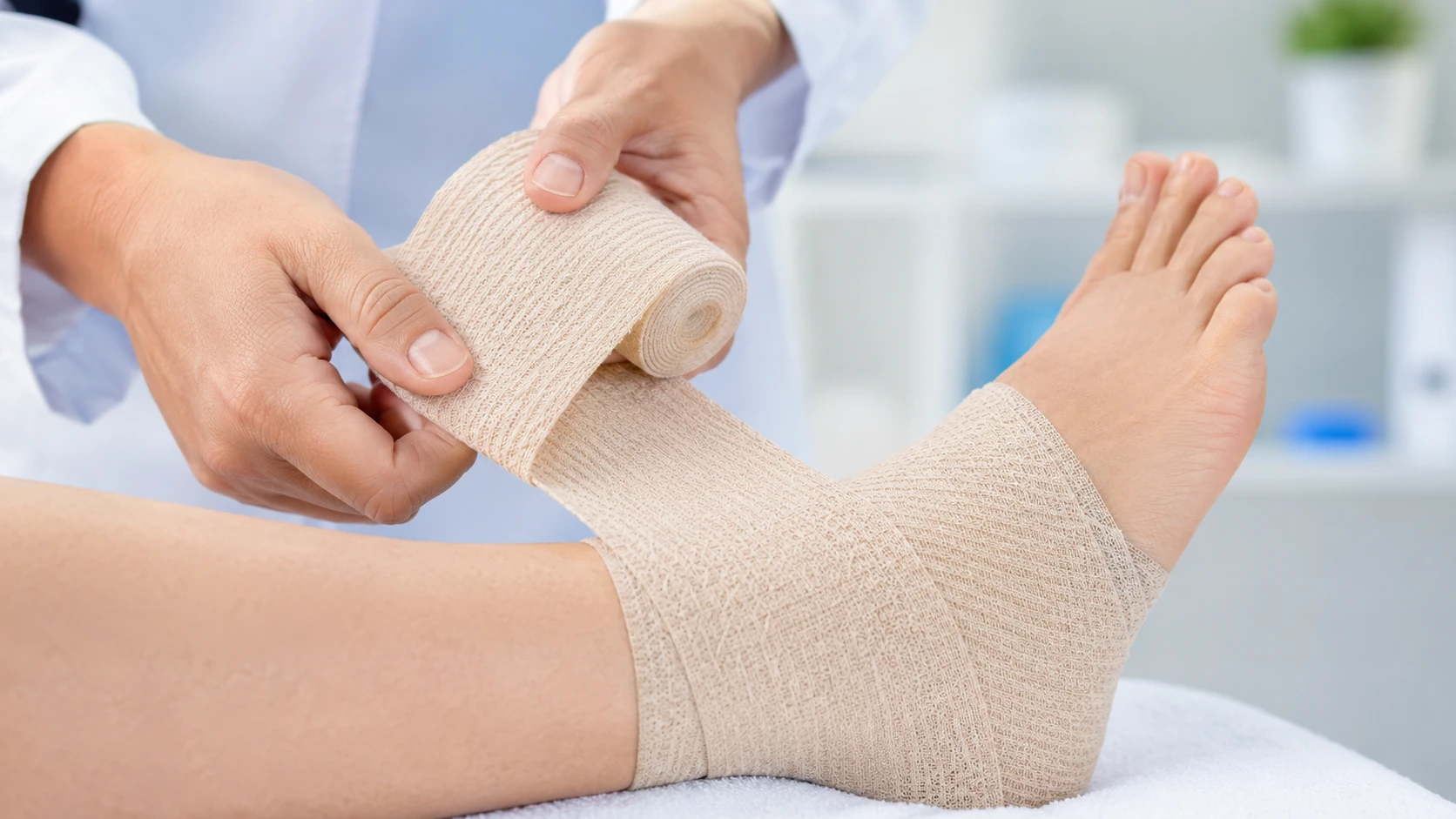
Elastic wrapping is commonly associated with minor ankle sprains and soft-tissue injuries where controlled support and compression may be recommended as part of the recovery plan.
Elastic bandage wrapped around an ankle
A wider elastic bandage may be used around the knee or other larger areas when supportive wrapping is appropriate and does not interfere with circulation or movement.
Hand, Wrist and Upper-Limb Support
Elastic bandages may also be used around the wrist, hand, elbow, or shoulder where flexible support is required, provided the injury is suitable for compression wrapping.
Stretch
Elastic fabric stretches during application so the bandage can adapt to the contours of the body and maintain close contact with the wrapped area.
Compression
Controlled tension creates external pressure around the area. The bandage should feel supportive but should never create pain, numbness, tingling, or colour changes.
Stability
The wrapped layers can provide additional external support around a joint or soft tissue while still retaining more flexibility than a rigid splint or cast.
Elastic Bandage
Elastic wrapping provides flexible support and adjustable compression. It may be appropriate for certain minor soft-tissue injuries where rigid immobilization is not required.
Splint, Brace or Cast
More significant injuries may require a brace, splint, cast, or another form of immobilization to protect the injured structures and limit movement more effectively.
An elastic bandage should not be used as a substitute for appropriate immobilization when a fracture, major ligament injury, dislocation, or other serious injury is suspected.
Body Area
The width of the bandage should match the size and shape of the body area being wrapped. Smaller areas generally require narrower bandages, while larger joints or limbs may benefit from wider coverage.
Required Support
Consider whether the objective is light support, temporary compression, securing another dressing, or additional stabilization as part of a broader treatment plan.
Bandage Width
Using an appropriately sized bandage makes it easier to create even overlapping layers without excessive bulk or gaps in coverage.
Elasticity
The stretch characteristics of the bandage influence how easily it conforms to the body and how much pressure can be generated during wrapping.
Skin and Circulation
The condition of the skin and circulation should be considered before applying compression. Bandaging should not create numbness, tingling, coldness, discoloration, or increasing pain.
Type of Injury
Elastic wrapping is not suitable for every injury. Severe pain, deformity, significant swelling, inability to use the limb, or suspected fracture should prompt professional assessment.
1. Position the Area
Place the injured area in a comfortable and supported position before beginning the wrap. Select a bandage width appropriate for the body part.
2. Apply Evenly
Wrap the bandage in smooth overlapping layers, maintaining even tension. The bandage should feel firm and supportive rather than excessively tight.
3. Check Circulation
After application, check for increasing pain, numbness, tingling, coldness, swelling beyond the wrap, or changes in skin colour. Loosen or remove the bandage if circulation appears affected.
Firm Enough to Support
The wrap should sit securely against the body and provide the intended support without repeatedly slipping, bunching, or becoming loose during normal movement.
Never Tight Enough to Restrict Circulation
Excessive compression can restrict blood flow. If fingers or toes become pale, blue, cold, numb, painful, swollen, or develop pins-and-needles sensations, the wrap may be too tight and should be addressed promptly.
Wrapping Too Tightly
Applying excessive tension can cause discomfort and interfere with circulation rather than providing appropriate support.
Creating Uneven Pressure
Wrinkles, rolled edges, gaps, or uneven layers can create localized pressure areas and make the wrap less comfortable or effective.
Using the Wrong Width
A bandage that is too narrow for a large joint may require excessive overlapping, while an unnecessarily wide bandage may be difficult to position on smaller areas.
Using a Bandage for a Serious Injury
Compression wrapping should not delay assessment of severe pain, major swelling, deformity, suspected fracture, loss of sensation, or inability to use the injured limb normally.
Smaller Body Areas
Narrower elastic bandages can make controlled wrapping easier around smaller anatomical areas such as the hand, wrist, or ankle.
Larger Body Areas
Wider bandages can provide broader coverage around larger areas such as the knee, thigh, or shoulder while reducing the number of overlapping layers required.
5 cm x 4.5 m
The narrowest Winner High Elastic Bandage option, suitable where compact coverage and more controlled wrapping around a smaller body area are required.
7.5 cm x 4.5 m
A medium-width option that provides additional coverage while remaining practical for many joint and limb applications.
10 cm x 4.5 m
A wider format for body areas that benefit from broader coverage and fewer overlapping turns of the bandage.
15 cm x 4.5 m
The widest Winner variant, providing greater surface coverage for larger body areas when this width is appropriate for the intended application.
Bandage width should be selected according to the body area, intended level of support, and application technique. Width alone does not determine the amount of compression—the tension applied during wrapping also affects pressure.
Severe or Unusual Symptoms
Seek appropriate medical assessment for severe pain, major swelling, significant bruising, joint instability, deformity, numbness, loss of normal movement, or inability to bear weight or use the injured area normally.
Symptoms That Do Not Improve
Professional assessment may also be appropriate when pain or swelling does not begin to improve as expected, symptoms worsen, or there is concern about a fracture, ligament injury, or other underlying problem.
What is a high elastic bandage used for?
A high elastic bandage is used to provide flexible support and adjustable compression around suitable joints or soft tissues. It may be used around areas such as the ankle, knee, hand, wrist, or shoulder depending on the injury and application requirements.
Can an elastic bandage help with swelling?
Compression wrapping is commonly used as part of the management of some minor soft-tissue injuries and may help manage swelling. It should be applied correctly and should not restrict circulation.
How tight should an elastic bandage be?
An elastic bandage should feel firm and supportive, but not painful or excessively tight. Numbness, tingling, coldness, colour changes, increased swelling, or worsening pain can indicate excessive pressure.
Can an elastic bandage replace a brace or cast?
Not necessarily. Elastic bandages provide flexible support, while more serious injuries may require a brace, splint, cast, or another form of immobilization determined by a healthcare professional.
How do I choose the right elastic bandage width?
Choose a width appropriate for the size and shape of the body area being wrapped. Smaller areas generally benefit from more manageable narrow widths, while larger areas may require broader coverage.
What sizes are available for Winner High Elastic Bandage?
Winner High Elastic Bandage is available in 5 cm x 4.5 m, 7.5 cm x 4.5 m, 10 cm x 4.5 m, and 15 cm x 4.5 m variants.
Flexible Support Starts With the Right Fit
An elastic bandage may look simple, but effective wrapping depends on choosing an appropriate width, applying even tension, and regularly checking comfort and circulation.
For suitable minor soft-tissue injuries and supportive wrapping needs, a high elastic bandage can provide a flexible way to support areas such as the ankle, knee, hand, wrist, or shoulder.
Winner High Elastic Bandage is made from 95 gsm elastic fabric and is available in four widths—5 cm, 7.5 cm, 10 cm, and 15 cm—with each variant supplied in a 4.5 m length.
The type and severity of injury, body area, required support, skin condition, and circulation should always be considered before applying compression.
Explore the related product for specifications, available sizes, and additional product information.