What is a surgical mask?
A surgical mask is a disposable, loose-fitting face covering that covers your nose and mouth. It forms a physical barrier to things around it. It may filter out some of what reaches your mouth and nose. As well as filter out some of what you breathe out towards others.
In the United States, the U.S. Food and Drug Administration regulates surgical masks under 21 CFR 878.4040. U.S. rules classify the mask part of “surgical apparel.” You may see these masks labeled as a surgical, dental, isolation, or medical procedure mask. You should never share a surgical mask with anyone. Some models add a clear plastic face shield for splash protection.
Structure of surgical masks
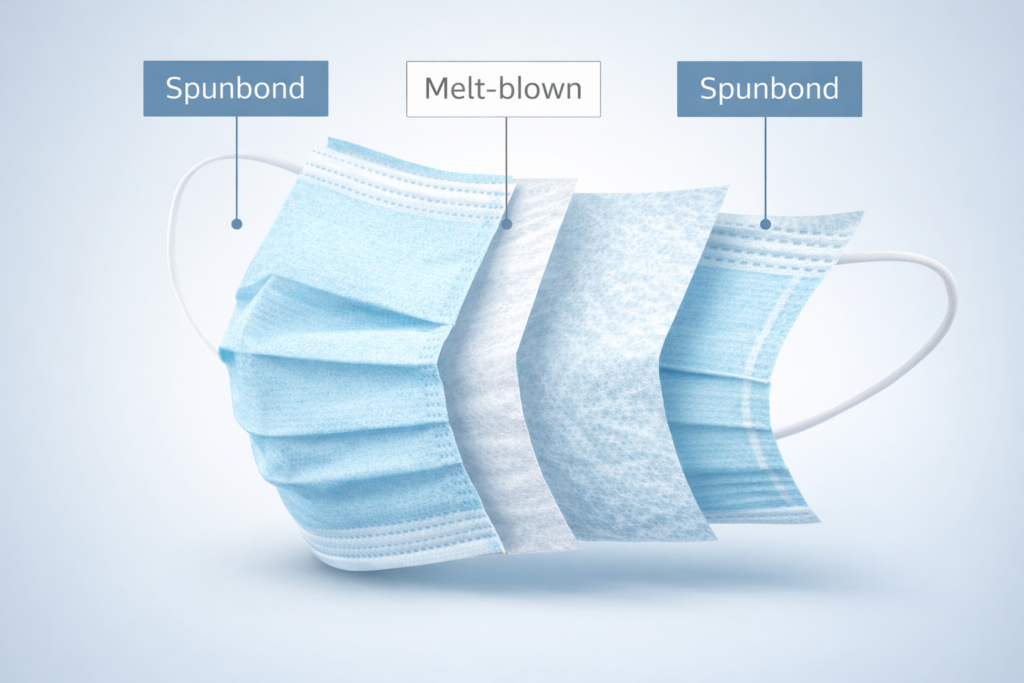
The most common structure in surgical masks is called “SMS”; it consists of spunbond, melt-blown, and finally spunbond. The middle section is the main filter. The outer and inner layers are generally made for durability and comfort.
The most common materials used are polypropylene for these layers. A soft inner layer may also be used, especially for patient skin contact. A water-resistant outer layer may also be used for splash resistance.
Various filter layers incorporate electret melt-blown fibers with electrostatic charge. The improvement in charge can increase the filter efficiency without a significant breathing cost. Research findings show a broad range in the weight of the filter layer. The amount of charge should be unknown unless the manufacturer provides the information.
What is a surgical mask used for?
Surgical masks primarily protect against droplets and splashes. Healthcare workers wear them for many routine activities or procedures. These masks filter out large droplets, sprays, and splashes. They also support “source control,” meaning they help manage respiratory secretions.
A surgical mask is not designed to fit snugly against your face. Breathing goes in and out along the edges. Because of this, they are not effective in protecting against tiny particles in the air. According to the Centers for Disease Control and Prevention and its National Institute for Occupational Safety and Health, surgical masks do not protect against respiratory aerosols.
Different types of surgical masks
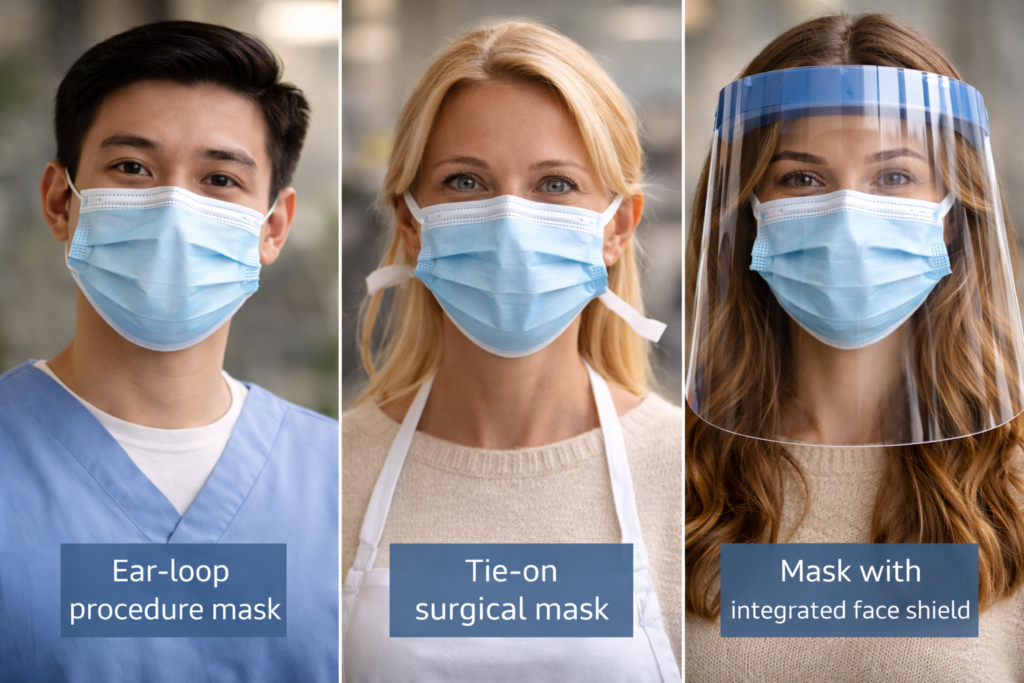
Ear-loop procedure masks
These masks come equipped with ear loops made of elastic and a nose wire. Best for short tasks and minimal fluid exposure. Comfortable, but the gaps around cheeks can stay big. Use a knot and tuck to help eliminate leaks.
Tie-on surgical masks
These kinds of masks use ties that are put on the head and the neck. These can be useful, especially if you want to eliminate ear bar. However, they are more difficult to put on, and the ties can rip off when removing. Use ties if you want more steadiness.
ASTM F2100 Level 1, 2, and 3 masks
ASTM International advises on ear-loop and tie mask ratings, using filtration, breathability tests, and synthetic blood tests. Level 1 is for minimum fluid exposure, and Level 3 is for higher splatter risks. This rating does not cover leakage between edges.
EN 14683 Type I, II, and IIR masks
The standard requires the incorporation of a filter layer. The filtration and breathability are also specified. Type I is for patient or community usage. Type II provides better filtration, and Type IIR is for splash resistance. Pinch the bridge of the nose and check the side gaps.
Fluid-resistant splash masks
The makers enhance liquid resistance for the outer layer. These types of masks usually meet ASTM level 2-3 and EN Type IIR. They are useful when one is undergoing dental procedures and surgeries with fluid sprays. Press the wire for the nose and keep it over the chin.
Masks with integrated face shields
These masks come with a visor attached to the mask. The visor will protect eyes from any spray or drops. Fogging will affect the comfort level. A good mask-gasket seal is also necessary around the edges.
Pediatric surgical masks
These wear use smaller shapes for smaller faces. Research has reported common sizes, though no standard has mandated one specific size. An effective fit must cover the nose and chin areas completely.
Enhanced-fit surgical masks and fit aids
Additionally, some of the masks include stiffer nose wires. Others include straps for adjustability. Braces are used to reduce gaps. In some instances, people use the knot-and-tuck technique. In the CDC simulation tests, improvements were shown for fitting.
Difference between Surgical Masks and Surgical N95 Respirators
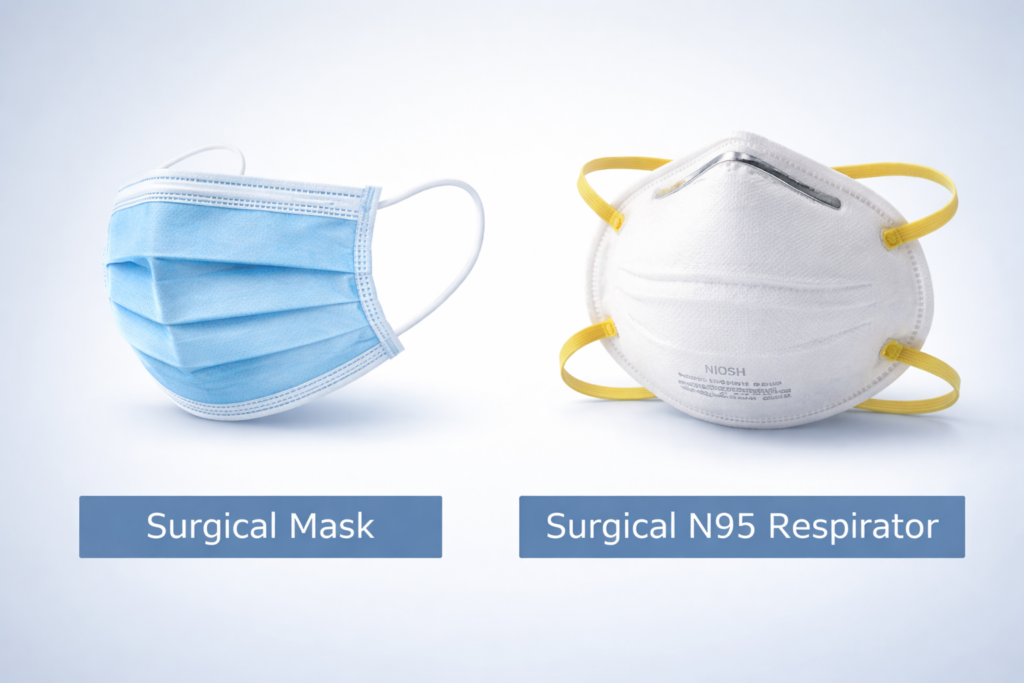
Surgical masks and surgical N95 respirators both serve important roles in infection control, but they are designed for different levels of protection. A surgical mask is used for blocking or controlling the entry of respiratory droplets and splashes into the respiratory system. The surgical mask is loosely fitted over the nose and the mouth, and since it allows air leakage during breathing, it can only be used for source control. The surgical mask will help in controlling the spread of the infection from the patient and to the patient.
In contrast, a surgical N95 respirator is intended to protect the user from not only large airborne particles, but also from very small airborne particles. The respirator creates a seal to the user’s face, which is able to filter at least 95% of airborne particles when the respirator is appropriately fitted to the user’s face. Unlike the other two types of surgical masks, the surgical N95 respirator often requires a fit test to be administered in a health care setting to seal appropriately on the user’s face.
Another key difference relates to the environment of use. Surgical masks are common in routine medical care and community settings where droplet transmission is the main concern. Surgical N95 respirators are recommended in high-risk healthcare environments, especially during aerosol-generating procedures or when treating airborne infectious diseases.
| Feature | Surgical Mask | Surgical N95 Respirator |
| Fit | Loose | Tight seal |
| Filters small airborne particles | No | Yes (≥95%) |
| Protects wearer from aerosols | Limited | Strong protection |
| Fit testing required | No | Yes (in healthcare settings) |
| Typical straps | Ear loops | Head straps |
Things to avoid in wearing surgical masks
Start with clean hands each time you handle a mask. Cover your nose, mouth, and chin. Press the nose strip to reduce gaps. Remove the mask by the straps, not the front. Throw away disposable masks after one use, or sooner if wet.
Things to avoid:
- Wearing the mask under your nose
- Leaving gaps at the cheeks
- Touching the mask front while wearing it
- Sliding it to your chin between uses
- Reusing a wet or dirty disposable mask
- Sharing masks with anyone
- Removing it without cleaning hands
- Wearing it once breathing feels difficult
FAQ: Can Surgical Masks Be Reused?
Surgical masks are designed for single use and should not be reused because their protective ability decreases over time. As you breathe, moisture builds up inside the mask, which weakens its filtration efficiency and makes it less effective. At the same time, the outer surface can collect droplets, bacteria, and other contaminants, increasing the risk of transferring germs if the mask is handled or worn again.
Repeated use can also stretch the ear loops, distort the nose wire, and create gaps that reduce protection. For these reasons, a surgical mask should be discarded once it becomes damp, dirty, damaged, or after several hours of wear, and proper hand hygiene should always follow removal.
FAQ: Do cloth masks provide good protection?
Cloth masks can provide basic protection, but their effectiveness depends heavily on the fabric, fit, and number of layers. Unlike medical-grade masks, cloth masks are not standardized, so performance varies widely. A well-made cloth mask with multiple layers of tightly woven fabric can help reduce the spread of respiratory droplets, especially in low-risk community settings. However, they generally do not filter very small airborne particles as effectively as surgical masks or N95 respirators.
Fit also plays a major role. Gaps around the nose and cheeks allow air to leak in and out, which reduces protection
FAQ: Do Surgical Masks Help in Preventing the Nipah Virus?
Yes, surgical masks can reduce the risk of Nipah virus transmission, but protection depends on the situation. The virus spreads mainly through close contact with infected individuals, contaminated body fluids, or animals such as fruit bats and pigs. It can also spread through respiratory droplets during prolonged close contact.
Surgical masks block large respiratory droplets, which helps reduce person-to-person transmission in routine or lower-risk healthcare and community settings. They work especially well for source control.
However, high-risk environments such as hospitals treating confirmed cases or aerosol-generating procedures require stronger protection. In those situations, healthcare workers should use N95 respirators and full personal protective equipment (PPE) because these provide a tighter seal and higher filtration efficiency.